Brand Activation Agency: How to Choose the Right Partner for Your Campaign
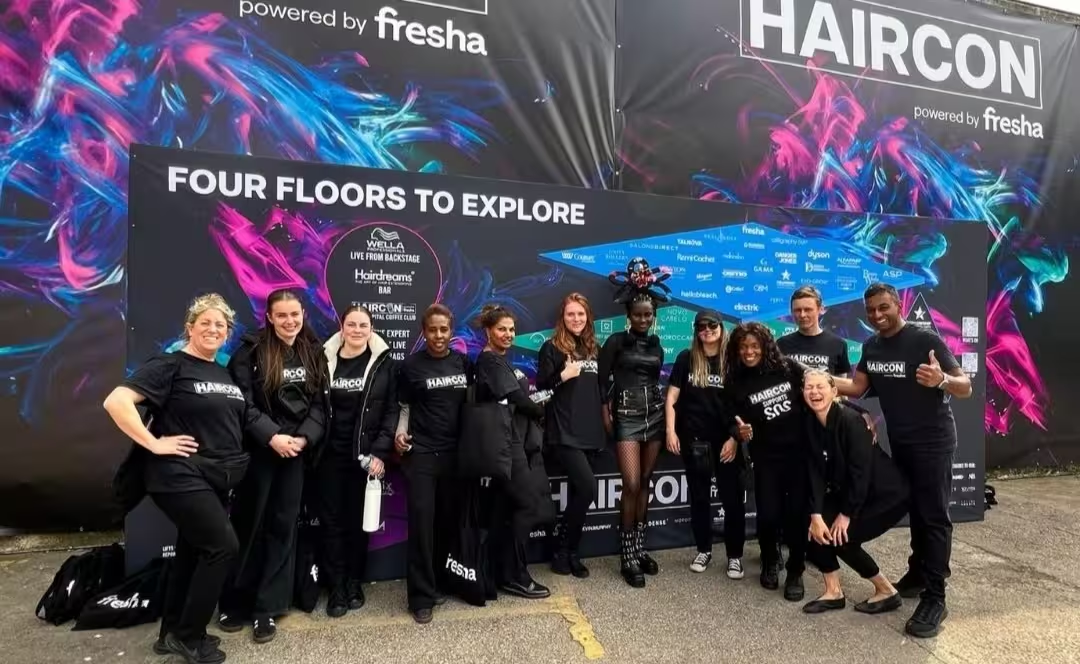
A Brand Activation Agency is a specialist strategic and creative firm that conceptualises, produces, and executes live, immersive experiences designed to bring a brand to life and forge direct emotional connections with consumers.
Imagine launching a flagship product in the heart of London: the lights glisten off architectural glass in the West End, curated ambient scents fill the air, and an expectant crowd gathers at your pop-up installation. Yet, if the lighting rig flickers, the street permits are contested by local council wardens, or the promotional staff lack the poise to articulate your luxury heritage, the entire high-stakes moment evaporates into reputational risk. In the world of high-end experiential production, execution is everything.
Partnering with an elite creative producer ensures every logistical, spatial, and human touchpoint is impeccably orchestrated. From high-impact luxury pop-ups in Central London to multi-city field marketing roadshows across Manchester, Birmingham, and Edinburgh, bringing your brand architecture into the physical realm requires absolute precision. Discover what brand activation in marketing truly encompasses and how the right agency partner elevates live engagement from simple promotional noise into high-converting brand equity.
What is a Brand Activation Agency?
A Brand Activation Agency is an expert event production and promotional management company that designs interactive physical and hybrid environments to drive direct consumer engagement, trial, and brand loyalty. Beyond standard media buying or digital ad placement, these agencies bridge the gap between abstract corporate identity and tangible human experience.
The Experiential Advantage: Modern consumers no longer consume brands passively; they demand physical touchpoints, authentic dialogue, and shareable real-world interactions that resonate on a sensory level.
When executed properly, live activations transform audiences from passive observers into active brand advocates. Agencies deliver this transformation across several core disciplines:
- Bespoke Experiential Marketing: Crafting immersive environments, tactile exhibits, and sensory spaces that captivate attendees.
- Product Launch Event Management: Executing flawless debuts for luxury, automotive, beauty, and tech products in premier venues.
- High-Impact Field Marketing: Mobilising nationwide sampling, street-level engagements, and direct-to-consumer pop-ups.
- Elite Event Staffing: Deploying highly trained brand ambassadors, hosts, and managers who seamlessly embody your corporate ethos.
What is Experiential Marketing?
Experiential marketing is a strategic engagement discipline that immerses consumers in direct, sensory-rich brand interactions to build lasting emotional connections and drive measurable commercial action. By engaging touch, sight, sound, and smell, live experiences bypass traditional advertising fatigue, cultivating deep affinity that digital impressions alone cannot achieve. Exploring the psychology of experiential marketing reveals how multi-sensory touchpoints anchor brand memory far more effectively than static visual ads.
The Sensory Engagement Engine
- Sight: Architectural set design, ambient lighting, and high-impact iconography.
- Sound: Curated soundscapes, spatial acoustics, and direct dialogue.
- Touch: Tactile product sampling and interactive installations.
- Smell: Bespoke ambient scents and aromatic product notes.
Engaging these sensory pillars creates neural memory retention, leading to deeper emotional resonance, elevated trust, and immediate commercial conversion.
Strategic Objectives of Live Activations
Every bespoke campaign executed by a premier brand activation agency targets key commercial imperatives:
- Brand Awareness & Differentiation: Elevating brand visibility in high-footfall cultural and financial hubs.
- Immediate Product Trial: Allowing consumers to touch, test, and experience product quality firsthand, significantly reducing the barrier to purchase.
- Sensory Brand Engagement: Harnessing sensory marketing techniques to trigger emotional responses that build long-term affinity.
- First-Party Data Capture: Collecting actionable customer insights, digital opt-ins, and survey feedback in real time.
- Organic Amplification: Designing aesthetically striking, shareable installations that encourage social content creation and extend campaign reach exponentially.
How to Choose the Right Brand Activation Agency
Choosing the right brand activation agency requires a rigorous evaluation of their creative vision, logistical capability, sector-specific expertise, and elite staffing network. Partnering with an under-resourced team risks supply chain disruptions, council compliance errors, and sub-par brand representation. To make an informed decision, refer to the executive guide to choosing an event management company.
Agency Selection Checklist
- Sector Expertise: Review case studies in luxury, FMCG, retail, or tech to ensure relevant experience.
- In-House Staffing: Verify direct roster access rather than relying on multi-tiered agency sub-letting.
- Logistical Rigour: Audit RAMS (Risk Assessment and Method Statements), safety protocols, and council licensing capabilities.
- Measurement Capability: Review footfall analytics, lead-capture tech, and ROI modeling frameworks.
Core Evaluation Criteria
- Sector Expertise & Portfolio Proof: Ensure the agency has a proven track record executing campaigns of similar scale and complexity within your specific sector.
- Strategic Rigour vs Pure Aesthetics: A stunning installation is meaningless if it fails to drive commercial growth. The agency must align creative concepts with your core KPIs.
- In-House Production & Staffing Control: Agencies that maintain direct control over their staffing rosters and production logistics deliver superior quality control compared to those that outsource critical operations.
- Cultural Compatibility & Communication: Select a team that acts as an extension of your internal marketing department, operating with complete transparency and adaptability.
How to Plan a High-Impact Brand Activation
Planning a high-impact brand activation involves a meticulous, phase-by-phase roadmap that aligns strategic objectives, audience profiling, creative architecture, and venue logistics into a unified master strategy. Understanding why brand activations matter is the catalyst for investing the necessary planning rigour into every execution phase.
Phase 1: Objective Setting & SMART Alignment
Before drafting creative concepts, establish explicit, quantifiable goals using SMART goals for event planning. Determine whether your primary metric is footfall volume, direct sample distribution, digital lead acquisition, or immediate point-of-sale uplift.
Phase 2: Granular Audience Profiling
Identify precisely who you are targeting, their behavioural habits, and where they congregate. A luxury fashion pop-up targeted at high-net-worth individuals in Mayfair requires an entirely different sensory aesthetic, tone of voice, and operational rhythm than an interactive gaming activation at the NEC Birmingham.
Phase 3: Creative Concept Architecture
Develop a central creative narrative that weaves your brand story through physical and digital touchpoints. The activation must offer immediate visual clarity, intuitive navigation, and compelling interactive elements that prompt immediate consumer participation. Explore 5 ways to make your brand stand out at events to refine your structural design.
How Brand Activation Agencies Deliver Live and Digital Experiences
Delivering live and digital experiences requires seamless coordination across venue procurement, structural fabrication, technical engineering, and elite personnel deployment. Whether executing bespoke corporate events management or high-volume urban street campaigns, an experienced brand activation agency guarantees operational excellence at every step.
Event Production & Technical Engineering
Flawless live execution rests on solid structural and technical foundations. Production management encompasses:
- Site Surveying & Spatial Planning: Mapping high-footfall locations in venues like Westfield London, Victoria Square Birmingham, or Manchester's Spinningfields.
- AV & Lighting Design: Crafting mood-defining visual and acoustic landscapes using commercial-grade sound systems and architectural LED arrays.
- Custom Fabrication: Building bespoke display structures, pop-up kiosks, and immersive environments that adhere to strict safety codes.
Elite Event Staffing & Management
The human element dictates the success or failure of any physical event. The finest production setup will fail if represented by disengaged staff. Partnering with top-tier staffing specialists ensures your team consists of articulate, impeccably trained professionals. Discover the strategic rationale in why staffing is the key to successful brand experiences.
Agencies supply diverse, specialised event talent tailored to your campaign requirements:
- Event Managers: Experienced directors who oversee logistics, manage emergency protocols, and maintain quality standards on-site. Discover the key traits of a successful event manager and learn what an event planner does during high-pressure activations.
- Brand Ambassadors: Engaging, well-spoken representatives trained to articulate complex brand narratives and drive product trial. Learn how brand ambassadors strengthen customer connections.
- Promotional Talent: Specialists focused on high-volume sampling, leafleting, and crowd management. Compare options in brand ambassadors vs promotional models and explore the nuanced differences in promotional staff vs promotional models.
- Scalable Operations: Implementing temporary event staffing strategies to scale teams effortlessly during peak seasonal campaigns.
Consulting the expert guide to the best event staffing agencies in London highlights why bespoke recruitment makes all the difference. When evaluating partners, review 3 critical factors when partnering with a staffing agency and evaluate the pros and cons of an event staffing agency vs an in-house team.
Field Marketing & Retail Activations
Direct field marketing places your product directly into consumer hands within high-footfall commercial zones. From retail sampling counters to urban street interventions, executing 20 high-impact field marketing activities relies on detailed spatial planning and precise audience targeting.
Understanding what a field marketing agency does clarifies how field activations complement broader event strategies. Explore our specialised field marketing services and master proven field marketing strategies to maximise footfall conversion. Furthermore, analysing field marketing vs event marketing helps determine the optimal balance for your brand lifecycle.
Digital Integration & Hybrid Marketing
Modern activations extend far beyond physical footfall through integrated digital touchpoints. By incorporating live streaming, augmented reality (AR) filters, digital leaderboards, and social sharing incentives, brands transform localised activations into global digital moments. Explore what hybrid event marketing is to seamlessly bridge the gap between offline experiences and online engagement.
How to Manage Budgets, Timelines, and Risk in Event Production
Managing budgets, timelines, and legal risks in event production requires structured oversight, robust financial planning, detailed contingency margins, and complete regulatory compliance across all UK venues. Without thorough risk management, unforecasted operational delays or council fines can quickly undermine campaign profitability.
Step-by-Step Production Timeline Roadmap
- Weeks 12–9 (Briefing & Strategy): Finalise creative design, secure venue bookings, submit council permits (e.g., London borough highways licences), and establish target KPIs.
- Weeks 8–5 (Production & Sourcing): Complete structural fabrication, source AV infrastructure, recruit specialised promotional staff, and draft detailed campaign briefings.
- Weeks 4–2 (Compliance & Testing): Finalise Risk Assessment and Method Statements (RAMS), secure Public Liability Insurance, run technical rehearsals, and brief field managers.
- Week 1 (Execution & Build-In): Manage live setup, execute real-time data capture, coordinate talent, oversee immediate de-rig, and restore the venue site.
- Post-Event (Analytics & Reporting): Consolidate footfall data, calculate ROI metrics, process lead databases, and repurpose captured media assets.
Financial Management & Contingency Planning
Transparent budget allocation prevents financial surprises during campaign execution. Ensure your financial breakdown accounts for key operational categories:
- Production & Structural Build: Material sourcing, set construction, custom props, and AV equipment rental.
- Site Hire & Local Authority Licensing: Venue fees, street trading licences, and council land-use permits across UK hubs.
- Talent & Staffing Fees: Competitive hourly/daily rates, staff travel allowances, management overheads, and tailored briefing sessions. Discover the financial return on expert personnel in the benefits of hiring promotional staff.
- Logistics & Warehousing: Transport, secure overnight storage, freight handling, and waste management.
- Contingency Reserve: Allocate a mandatory 10–15% buffer for last-minute venue changes, weather adaptations, or urgent technical additions.
Health, Safety, and Regulatory Compliance
Compliance across UK public spaces demands strict documentation. Your agency partner must manage:
- Comprehensive RAMS Protocols: Detailed Risk Assessment and Method Statements covering crowd flow, structural integrity, and electrical safety.
- Public Liability Cover: A minimum of £10 million Public Liability Insurance for high-volume public activations.
- Specialised Certification: Food hygiene qualifications for sampling campaigns, alcohol licences (TENS) where applicable, and certified technicians for working at height.
How to Measure Experiential Marketing ROI
Measuring experiential marketing ROI requires tracking explicit quantitative metrics, evaluating qualitative sentiment changes, and calculating the net commercial value generated relative to total campaign spend. Understanding why experiential marketing is so powerful relies on translating real-world consumer engagement into clear financial metrics.
Key Performance Formulas
- Return on Investment (ROI): Total Revenue Generated minus Total Campaign Investment, divided by Total Campaign Investment.
- Cost Per Engagement (CPE): Total Campaign Budget divided by Total Direct Interactions.
- Sample Conversion Rate: Purchases Made divided by Total Samples Distributed, multiplied by 100.
Essential Campaign Metrics & Field Marketing KPIs
To properly quantify success, agencies track core field marketing KPIs across three main layers:
- Direct Engagement Volume: Total footfall count, dwell time per interaction, samples distributed, and product demonstrations completed.
- Lead Acquisition & Digital Tracking: QR code scans, survey completions, newsletter opt-ins, and app downloads recorded on-site.
- Commercial Conversion: Point-of-sale revenue spikes, post-event voucher redemptions, and long-term customer lifetime value (LTV) growth.
Advanced Data Collection Methodologies
Modern field environments utilise advanced technology to record consumer actions accurately:
- Optical Footfall Sensors & Heatmaps: Measuring foot traffic density, dwell zones, and movement patterns within pop-up environments.
- Digital Badge Scanners & RFID: Capturing B2B attendee details instantly at corporate launches or trade exhibitions.
- Post-Event Sentiment Surveys: Deploying immediate digital micro-surveys to evaluate changes in brand perception and purchase intent.
Building Long-Term Brand Momentum
Building long-term brand momentum ensures that the excitement generated during a live activation continues to drive consumer engagement, digital retargeting, and sales conversions long after the physical event closes. If your brand identity requires modernising, explore why updating your brand is good before launching a major activation.
Post-Event Retargeting Protocols
Do not allow consumer relationships to end when the live activation concludes. Implement immediate follow-up mechanisms:
- Automated Email Nurture Sequences: Send tailored post-event thank-you communications within 24–48 hours, including exclusive digital incentives or discount codes.
- Custom Audience Ad Retargeting: Build retargeting audiences based on on-site QR scans and website visits generated during the event.
- Direct SMS & App Notifications: Send time-sensitive offers to consumers who opted into mobile updates during the event.
Strategic Content Repurposing
- High-Res Event Photos: Repurpose captured imagery into website hero banners, social media galleries, and press releases.
- Attendee Video Interviews: Transform real-world reactions into customer testimonial reels and paid digital video ads.
- Behind-the-Scenes Footage: Edit technical builds and setup footage into short-form social content and featurettes.
- Live Product Demonstrations: Package live demonstration clips into digital product explainers for e-commerce landing pages.
FAQs about Brand Activation Agency
What does a brand activation agency do?
A brand activation agency conceptualises, plans, and executes experiential marketing campaigns, pop-up events, field activations, and product launches to engage consumers directly. They manage the entire project lifecycle, including creative design, venue procurement, council permitting, technical build, event management, elite promotional staffing, and post-campaign ROI reporting.
How much does a brand activation campaign cost in the UK?
A brand activation campaign in the UK typically costs between £10,000 for localised street-level sampling activations and upwards of £150,000 to £300,000+ for multi-city pop-up tours, complex venue builds, or flagship luxury launches in Central London. Total costs depend on venue hire fees, structural design complexity, technical AV requirements, licensing, and staffing scale.
How do I select the best brand activation agency for my campaign?
Selecting the best brand activation agency requires evaluating their past case studies in your sector, verifying that they maintain direct in-house control over event staffing rosters, auditing their health and safety protocols (RAMS), and ensuring they provide clear, data-driven post-campaign analytics to measure ROI.
What are the most effective examples of brand activation campaigns?
The most effective examples of brand activation campaigns include interactive pop-up retail stores in high-footfall shopping centres, immersive sensory sampling experiences, branded street activations, product launch debuts featuring live interactive technology, and hybrid physical-digital installations.
What is the difference between field marketing and event marketing?
Field marketing focuses primarily on direct, high-volume consumer interactions in everyday public settings through activities like product sampling, leafleting, and retail demos. Event marketing involves creating structured, destination-based experiences such as corporate launches, pop-up events, trade shows, and brand galas.
Start Your Next Bespoke Brand Activation
Delivering high-stakes live experiences requires a partner who combines creative distinction with absolute logistical control. At The Ann Savva Group, we bring luxury brand visions to life through world-class production, strategic field marketing, and elite staffing teams across London and major UK marketing hubs.
Discover our full range of comprehensive event solutions, explore our overarching expertise on The Ann Savva Group homepage, or consider joining our elite talent team if you represent the gold standard in brand representation.
Ready to transform your brand footprint and captivate your audience? Contact our expert team today to book a bespoke consultation.